projects and services
Baltimore City Composting Facility
THE END OF A COMPOSTING ERA
Baltimore City Composting Facility Received Last Delivery for Processing on June 30, 2026.
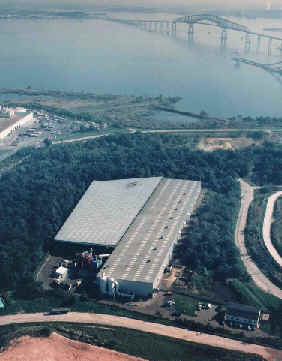
A small facility, sitting on a postage stamp parcel of land near the City of Baltimore’s Quarantine Road landfill quietly ended a 37-year production run this June 30 2026. Local and regional landscapers were the primary customers for the finished Class A compost produced at the Baltimore City Compost Facility (BCCF). The BCCF was operated under an Authority contract by Veolia North America, for the benefit of the City of Baltimore. Over the years, the Class A compost was used on turf at the Naval Observatory, Caves Valley Golf Club (host of the 2002 PGA Senior Open), the Congressional Golf Course, the White House, and many golf courses in the Mid-Atlantic. The biosolids from the Back River Wastewater Treatment Plant were combined with ground pallet wood, sawdust, peanut hulls, wood ash and recycled materials, and placed into a bunker inside of the reactor building for the composting processing to start. Temperature, moisture and oxygen were actively monitored, and the material was mixed and moved through the chamber over a period of approximately two weeks. This active composting period was to ensure that the mix met the time/temperature standards under federal and state regulations. After this time in the reactor building the material was moved outside via conveyors. Further maturation of the compost was completed under cover on an aerated pad. Once the mate rial was stable, roughly 44 days from the time it was received, it was passed through a screen to remove oversized carbonaceous materials to create a consistent product. The screened-out overs were recycled back into the process as amendment for mixing with new deliveries of biosolids. The facility was an example of materials processing on a small footprint that could make a measurable impact. Environmental engineering students from Johns Hopkins University visited the facility in the early 2000’s, and the facility was a regular tour site for University of Maryland Better Composting School. The facility was featured in tours for the 2003 WEF/AWWA/CWEA* Conference held in Baltimore. From 1997 forward the facility consistently sold out of finished product. During those 29 years, nearly one million tons of biosolids from Back River WWTP were processed into more than 1.2 million cubic yards of finished compost.